
What Is a PDF Summarizer and How Does It Work?
What Is a PDF Summarizer and How Does It Work?
In our information-overloaded world, reading through lengthy PDF documents can be time-consuming and overwhelming. Whether you're a student reviewing research papers, a professional analyzing reports, or a researcher sifting through academic articles, PDF summarizers have become essential tools for efficient information processing.
What Is a PDF Summarizer?
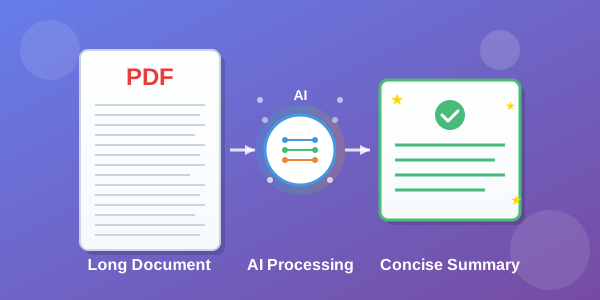
A PDF summarizer is an AI-powered tool that automatically reads and analyzes PDF documents to generate concise summaries capturing the key points, main ideas, and essential information. Think of it as having a smart assistant that reads documents for you and provides a digest of the most important content.
Key Features of Modern PDF Summarizers
**Intelligent Content Extraction**: Advanced algorithms identify and extract the most relevant information from text, tables, and even images within PDFs.
**Contextual Understanding**: AI models comprehend the context and relationships between different sections, ensuring summaries maintain logical flow and coherence.
**Customizable Output**: Most tools allow you to adjust summary length and focus areas based on your specific needs.
**Multi-language Support**: Many summarizers work across different languages, breaking down language barriers in document analysis.
How Does PDF Summarization Technology Work?
1. Document Processing
The first step involves converting the PDF into machine-readable text:
- Text Extraction: OCR (Optical Character Recognition) technology converts scanned documents and images into editable text
- Structure Analysis: The system identifies headings, paragraphs, lists, and other structural elements
- Content Parsing: Metadata, formatting, and layout information are preserved for context
2. Natural Language Processing (NLP)
This is where the magic happens:
**Tokenization**: Breaking down text into smaller units (words, phrases, sentences) for analysis
**Semantic Analysis**: Understanding the meaning and relationships between words and sentences
**Entity Recognition**: Identifying key entities like names, dates, locations, and concepts
**Topic Modeling**: Determining the main themes and subjects discussed in the document
3. Content Selection
The AI determines what's important through multiple techniques:
**Frequency Analysis**: Identifying words and phrases that appear most often
**Position Weighting**: Content at the beginning and end of sections typically carries more weight
**Relevance Scoring**: Sentences containing key concepts receive higher importance scores
**Redundancy Removal**: Eliminating repetitive information to create concise summaries
4. Summary Generation
The final step creates the actual summary:
**Extractive Summarization**: Selecting and combining the most important sentences directly from the original text
**Abstractive Summarization**: Using AI to rephrase and rewrite content in new, concise language (more advanced)
**Hybrid Approaches**: Combining both methods for optimal results
Types of PDF Summarizers
1. Extractive Summarizers
- Pull exact sentences from the original document
- Maintain original wording and accuracy
- Faster processing time
- Best for: Technical documents, legal papers, research articles
2. Abstractive Summarizers
- Generate new sentences that capture the essence
- More human-like and readable summaries
- Require more computational power
- Best for: News articles, reports, general content
3. Keyword-Based Summarizers
- Focus on identifying and highlighting key terms
- Provide bullet-point summaries
- Quick overview generation
- Best for: Quick scanning, topic identification
Benefits of Using PDF Summarizers
Time Efficiency
**Save Hours of Reading**: A 50-page document can be summarized in minutes instead of hours
**Quick Research**: Rapidly assess whether a document is relevant before deep reading
**Batch Processing**: Summarize multiple documents simultaneously for comparative analysis
Improved Comprehension
**Key Points First**: Get the main ideas immediately to understand the document's value
**Better Retention**: Shorter summaries are easier to remember and review
**Focused Learning**: Concentrate on essential information without getting lost in details
Professional Applications
**Business Intelligence**: Quickly analyze reports, proposals, and market research
**Legal Review**: Scan contracts and legal documents for key terms and clauses
**Academic Research**: Review literature faster and identify relevant studies
**Medical Practice**: Stay updated with latest research papers and clinical studies
Use Cases Across Industries
Education
- Students: Summarize textbooks, research papers, and study materials
- Teachers: Review student submissions and prepare lesson materials
- Researchers: Scan literature reviews and academic publications
Business & Corporate
- Executives: Digest lengthy reports and proposals quickly
- Analysts: Process market research and competitive intelligence
- HR Teams: Review resumes and application documents
Legal & Compliance
- Lawyers: Analyze contracts, case files, and legal precedents
- Compliance Officers: Review regulatory documents and policies
- Paralegals: Prepare case summaries and document briefings
Healthcare
- Doctors: Stay updated with medical research and clinical trials
- Researchers: Review scientific papers and medical journals
- Administrators: Process patient records and medical reports
Choosing the Right PDF Summarizer
Key Features to Consider
**Accuracy**: How well does it capture the main points without missing critical information?
**Customization**: Can you adjust summary length and focus areas?
**Language Support**: Does it work with your required languages?
**Security**: How is your document data handled and protected?
**Integration**: Does it work with your existing tools and workflows?
Quality Indicators
- Coherence: Summaries should flow logically and make sense
- Relevance: Key points should accurately represent the document
- Completeness: Important information shouldn't be omitted
- Conciseness: Summaries should be significantly shorter than originals
Best Practices for Using PDF Summarizers
1. Verify Critical Information
Always cross-check important facts and figures from summaries with the original document, especially for legal, medical, or financial content.
2. Use Summaries as Starting Points
Treat summaries as overviews rather than complete replacements. Use them to determine if deeper reading is needed.
3. Adjust Summary Length Appropriately
- Quick Overview: 10-15% of original length
- Detailed Summary: 20-30% of original length
- Comprehensive Summary: 30-40% of original length
4. Consider Document Type
Different documents require different approaches:
- Research papers: Focus on methodology and conclusions
- Business reports: Emphasize findings and recommendations
- Legal documents: Highlight key terms and obligations
The Technology Behind Modern Summarizers
Artificial Intelligence Models
**Transformers and BERT**: Advanced neural networks that understand language context
**GPT Models**: Powerful AI systems capable of generating human-like summaries
**Custom NLP Models**: Specialized algorithms trained on specific document types
Machine Learning Approaches
**Supervised Learning**: Models trained on human-created summaries
**Unsupervised Learning**: Algorithms that learn patterns without explicit examples
**Reinforcement Learning**: Systems that improve through feedback and evaluation
Future of PDF Summarization
Emerging Trends
**Multi-modal Summarization**: Processing text, images, charts, and tables together
**Interactive Summaries**: Ask questions about the document and get specific answers
**Real-time Collaboration**: Team-based summarization with shared annotations
**Domain-Specific Models**: Specialized summarizers for medicine, law, science, etc.
Integration Possibilities
- Email Clients: Auto-summarize attachments
- Note-taking Apps: Integrate summaries with personal knowledge bases
- Project Management: Summarize project documentation automatically
- Research Databases: Provide instant summaries of all papers
Common Challenges and Solutions
Challenge 1: Complex Technical Content
**Solution**: Use domain-specific summarizers trained on technical materials or review summaries more carefully.
Challenge 2: Scanned or Image-based PDFs
**Solution**: Ensure your tool has strong OCR capabilities or pre-process documents for better text extraction.
Challenge 3: Non-English Documents
**Solution**: Choose tools with robust multi-language support or use language-specific summarizers.
Challenge 4: Very Long Documents
**Solution**: Break documents into sections and summarize each part, or use tools designed for long-form content.
Privacy and Security Considerations
Data Protection
**Encryption**: Ensure documents are encrypted during upload and processing
**Data Deletion**: Verify that documents are automatically deleted after summarization
**No Storage Policy**: Choose tools that don't store or retain your documents
**Compliance**: Look for GDPR, HIPAA, or other relevant compliance certifications
Best Security Practices
- Use tools with strong privacy policies
- Avoid uploading sensitive documents to unknown services
- Consider on-premise or private cloud solutions for confidential materials
- Review terms of service regarding data usage and retention
Measuring Summarization Quality
Evaluation Metrics
**ROUGE Score**: Measures overlap between generated and reference summaries
**Coherence**: How well the summary flows and makes sense
**Relevance**: Whether the summary captures the main points
**Conciseness**: Appropriate length without unnecessary information
Human Evaluation
- Readability: Is the summary easy to understand?
- Informativeness: Does it contain essential information?
- Accuracy: Are there any errors or misrepresentations?
- Usefulness: Does it serve its intended purpose?
Conclusion
PDF summarizers are transforming how we interact with information in the digital age. By leveraging AI and natural language processing, these tools save time, improve comprehension, and help us manage information overload more effectively.
Whether you're a student, professional, researcher, or business leader, understanding how PDF summarizers work can help you choose the right tool and use it effectively. As the technology continues to evolve, we can expect even more sophisticated features that make document analysis faster, smarter, and more accessible.
The key is to use summarization as a tool to enhance – not replace – critical reading and analysis. When used appropriately, PDF summarizers can significantly boost productivity and help you focus on what matters most in your work and studies.
Ready to experience the power of AI-driven summarization? Try our free PDF summarizer tool and transform how you process documents today.